Paddle board fishing delivers access to water that kayaks and boats cannot reach, with a quiet approach that does not disturb the fish. The right board makes the difference between a stable, productive session and a frustrating one. Here are the top picks for 2026.
✓ Independent reviews✓ Real-world stability testing✓ No paid placements✓ Updated April 2026
Paddle board fishing continues to grow because it offers something traditional fishing boats cannot: access to shallow flats, quiet casting positions, and the flexibility to move without disturbing the water around you.
Not all paddle boards are suitable for fishing, however. Stability, weight capacity, and the ability to carry and mount gear are critical factors that most all-around reviews ignore. A board that works well for yoga or recreational paddling can be an unstable, undersized platform the moment you add a tackle bag, sit in a kayak seat, and cast into a crosswind.
This guide focuses on the boards that genuinely work for fishing — tested for stability under gear load, evaluated for rigging and mounting options, and selected for durability across real on-water use. For budget-conscious buyers, see our best inflatable paddle boards under $1,000 guide, which covers several of the same boards at every price point.
Top 3 Paddle Boards for Fishing in 2026
Ranked by fishing suitability — stability, gear capacity, and rigging options.
Fishing from a paddle board places different demands on a board than casual paddling. Here are the four specifications that separate a functional fishing SUP from one that will frustrate you on the water.
Stability: Width and Deck Shape
A fishing SUP should prioritize stability above all other characteristics. Look for a board at least 33 inches wide with a flat, wide deck. Width provides initial stability when standing to cast; a flat deck ensures even weight distribution under a loaded gear setup.
Weight Capacity
Fishing gear adds weight faster than most paddlers expect. Tackle bags, coolers, dry storage, and a rod holder can add 30–60 lbs before you board. Aim for a capacity of 300 lbs or higher — more if you plan multi-item setups or tend to fish with a partner rotating on the board.
Rigging and Mounting Options
A bare deck limits your fishing setup significantly. Look for boards with D-rings for kayak seat or gear attachment, bungee storage for tackle and dry bags, and ideally an accessory mounting system like MAGNEPOD or ISLE-LINK for clean, configurable setups.
Deck Padding and Durability
Fishing sessions involve more deck contact than typical paddling — gear slides, tackle drops, and repeated crouching. Look for full or extended EVA foam deck padding for grip and comfort, and construction materials that resist surface scuffing and pressure damage over repeated heavy use.
The 3 Best Paddle Boards for Fishing in 2026
Full breakdowns of each board — what makes it work for fishing, where it excels, and who it is best suited for.
Best Overall#1 Overall Fishing Pick
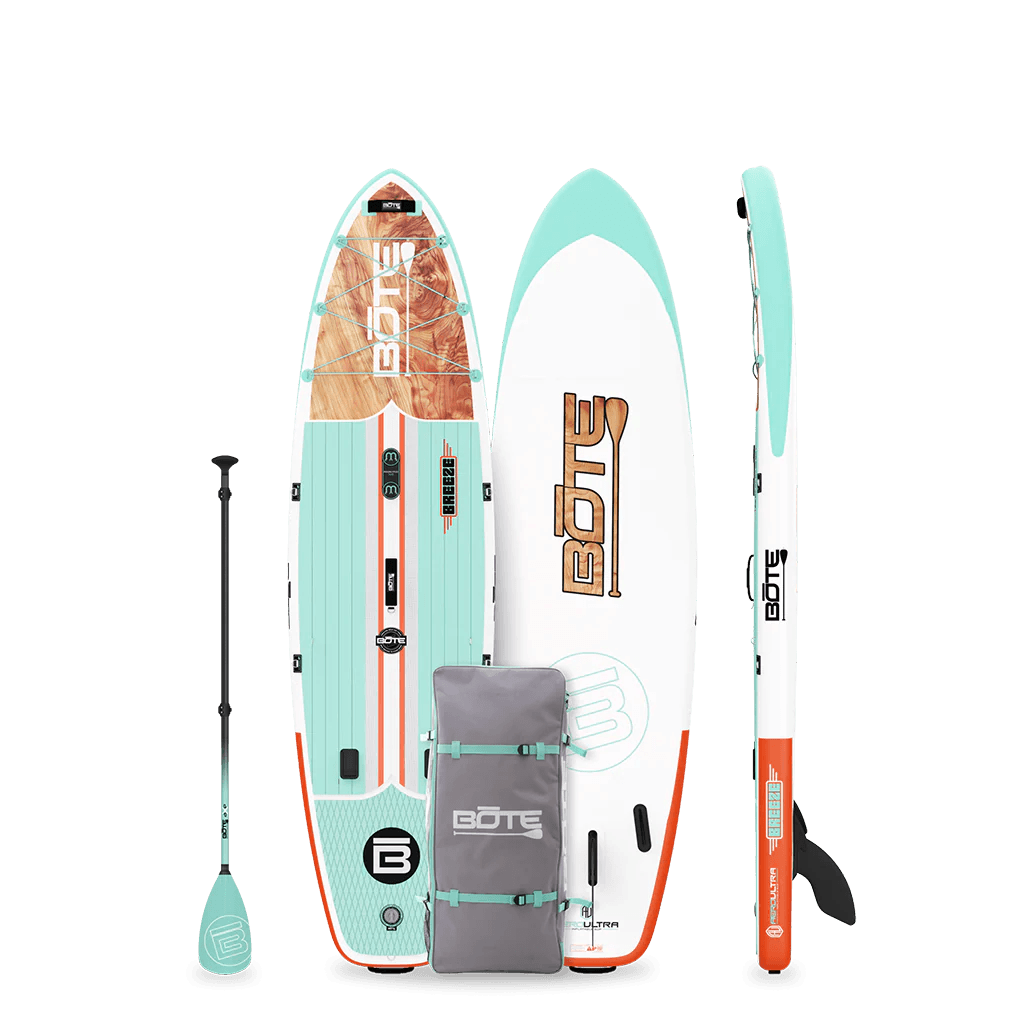
BOTE Breeze Aero 10'8"
Best Overall Fishing Paddle Board — ~$899
The BOTE Breeze Aero earns the top fishing pick for the same reason it earns the top all-around pick — it does more things well than anything else at this price. The 33-inch wide platform is stable enough for standing casts and controlled reeling, even when the board is loaded with a tackle bag, cooler, and a fish finder mount.
The MAGNEPOD magnetic accessory system is a meaningful advantage for fishing setups. It allows you to mount gear cleanly to the deck without looping bungee cords around accessories that shift under casting movement. Attach a cooler, a dry bag, or a rod holder and it stays put.
Durable AeroULTRA construction handles repeated contact with gear, paddles, and surfaces without the surface damage that lower-cost boards show quickly. For a board used hard on the water, that durability matters over a full season.
Pros
MAGNEPOD system provides clean, secure mounting for fishing gear
33-inch wide platform stays stable under casting and reeling movements
AeroULTRA construction handles repeated hard use without surface damage
All-around shape performs on lakes, rivers, and calm coastal water
Cons
300 lb weight capacity is lower than some dedicated fishing boards
MAGNEPOD fishing accessories are sold separately
Bottom line: The BOTE Breeze Aero is the most balanced fishing paddle board available at this price. Its MAGNEPOD system, strength, and stability make it the benchmark in the category.
Includes paddle, pump, fins, carry bag, and optional kayak seat.
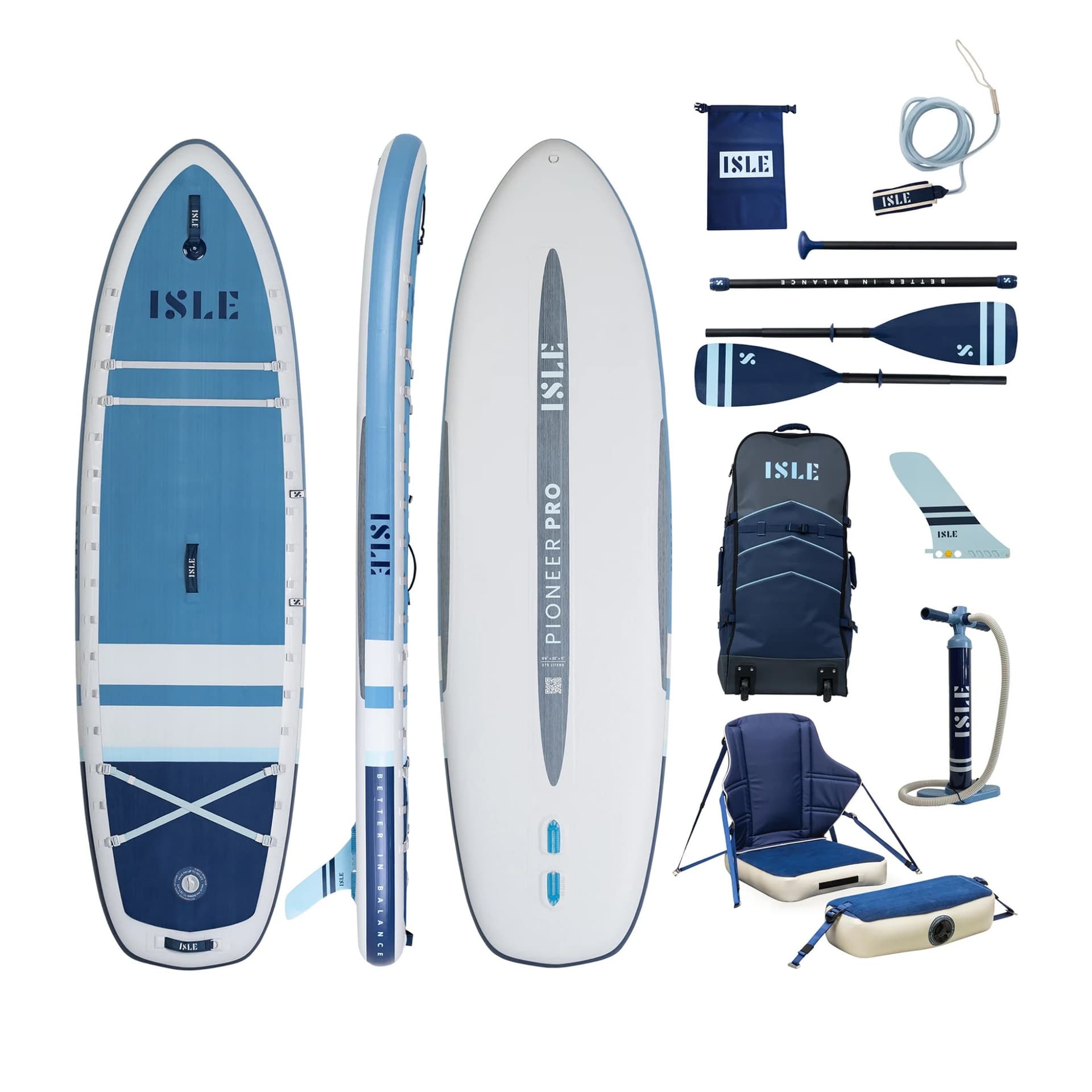
The Isle Pioneer Pro is designed for paddlers who want the board to keep up with their gear load, not the other way around. The 335 lb weight capacity — the highest of any board in this guide — accommodates a full fishing setup: kayak seat, tackle storage, dry bags, and a fish finder mount without the deck sinking into the water.
The ISLE-LINK rail system enables flexible gear configuration without permanent modifications. Attach a kayak seat for long sessions, rod holders for hands-free positioning, or a cooler mount for extended trips — and reconfigure in minutes when you want to paddle without gear.
Rigidity at 9.4 out of 10 on our field scale means this board behaves closer to a hardboard than most inflatables. A rigid platform reduces the micro-flex that makes casting from a SUP unstable, which is a practical advantage during a full fishing session.
Pros
335 lb weight capacity handles full fishing gear loads without deck sinking
ISLE-LINK system allows flexible, removable gear configuration
D-rings and bungee storage included for immediate rigging
Cons
At 18 lbs, slightly heavier than the BOTE Breeze Aero
At the upper edge of the sub-$1,000 price range
Bottom line: Choose the Isle Pioneer Pro if your fishing setups are gear-heavy. The weight capacity, ISLE-LINK system, and rigidity make it the most capable fully-rigged fishing SUP in this guide.
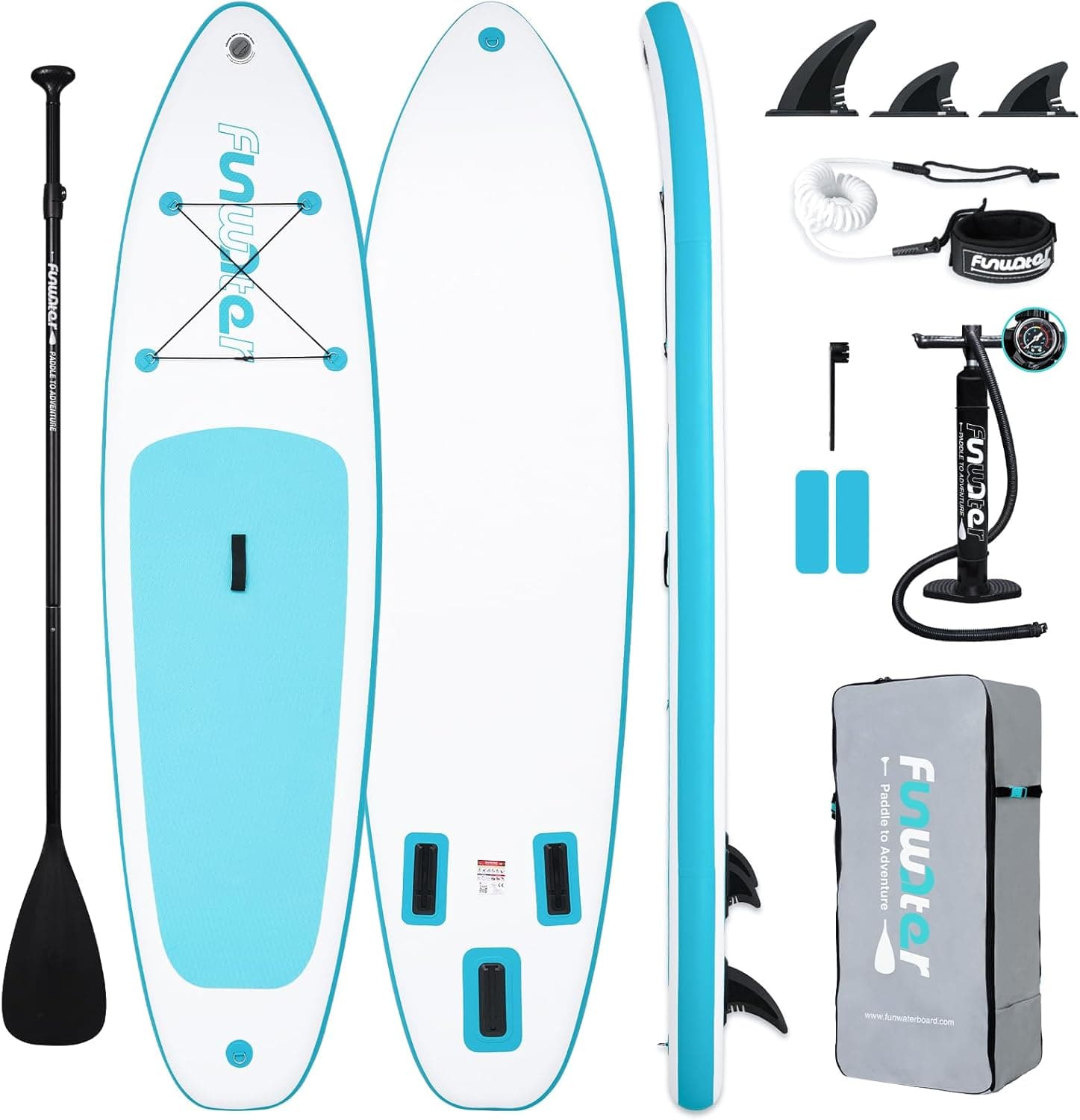
The FunWater inflatable SUP is the right answer for one specific buyer: someone who wants to try paddle board fishing before committing to a premium setup. At its price point, it removes the financial risk of a sport you may or may not continue.
On calm, protected water — a lake, a slow river, a sheltered bay — the FunWater provides adequate stability for standing casts. It is lightweight, packs down into a manageable carry bag, and inflates quickly. Those fundamentals are what matter for occasional fishing use.
It is not a board for open water, gear-heavy setups, or regular hard use. Build quality is below BOTE and Isle in materials and finish. As an introductory option for calm-water fishing, it serves its narrowly defined purpose.
Pros
Lowest entry price in the fishing category by a significant margin
Lightweight and straightforward to transport and store
Adequate stability for calm-water, light-gear fishing
Cons
Not suitable for open water, rough conditions, or heavy gear
Limited accessory mounting options compared to BOTE and Isle
Build quality and material finish below premium options
Not recommended for regular hard use or multi-season longevity
Bottom line: The FunWater is a sensible first step for testing the sport before investing in a premium board. Keep conditions calm and gear light.
The right accessories extend your time on the water, protect your gear, and reduce the physical effort of longer sessions. These three are the highest-impact additions to any fishing SUP setup.
YETI Sidekick Dry 6L
A reliable dry storage solution for protecting electronics, tackle, and valuables. Fully waterproof, stays secure on deck, and the 6-liter capacity handles a full day of essentials without adding bulk.
An electric pump removes the effort of manual inflation before a fishing session. The Vortex Pro reaches target PSI automatically and shuts off — faster startup, no wasted energy before you even reach the water.
A lighter carbon fiber paddle reduces arm fatigue on longer sessions and improves stroke efficiency. The weight difference between an aluminum and carbon paddle becomes noticeable within the first mile — worth the upgrade for regular fishing use.
The BOTE Breeze Aero is the best overall fishing paddle board in 2026, combining a stable 33-inch platform, MAGNEPOD accessory compatibility, and durable AeroULTRA construction. For gear-heavy setups requiring maximum capacity and modular rigging, the Isle Pioneer Pro is the stronger choice.
What width paddle board do I need for fishing?
For fishing, look for a paddle board at least 33 inches wide. Width is the primary driver of primary stability — the initial resistance to tipping when you shift weight during a cast or reel. A 32-inch board can work for light fishing in calm conditions, but 33 inches or wider provides meaningful extra confidence.
Can you fish from an inflatable paddle board?
Yes — inflatable paddle boards are well-suited for fishing in calm to moderate conditions. Premium inflatables like the BOTE Breeze Aero and Isle Pioneer Pro, inflated to 12–15 PSI, deliver rigidity close to hardboards and are stable enough for standing casts. Their portability also makes it easier to access spots inaccessible to kayaks and boats.
What accessories do I need for paddle board fishing?
Start with a dry storage bag for electronics and valuables (the YETI Sidekick Dry 6L is our top pick), an electric pump for quick inflation, and a carbon fiber paddle to reduce fatigue on longer sessions. From there, rod holders, a kayak seat for long waits, and a leash for safety are the most useful additions.
How do you stay stable on a paddle board while fishing?
Stability on a fishing SUP comes from board selection, inflation pressure, and stance. Choose a board at least 33 inches wide, inflate to the manufacturer's maximum recommended PSI, and keep your feet shoulder-width apart on the center of the board. Crouch or kneel if conditions get choppy — there is no penalty for adjusting stance when it keeps you on the board.
Related Guides
Looking for budget options, detailed brand comparisons, or beginner-specific advice? These guides address the next most common questions.