Performance Review
11 field sessions including 3 multi-hour touring routes. Here's what separates this board at the high end.
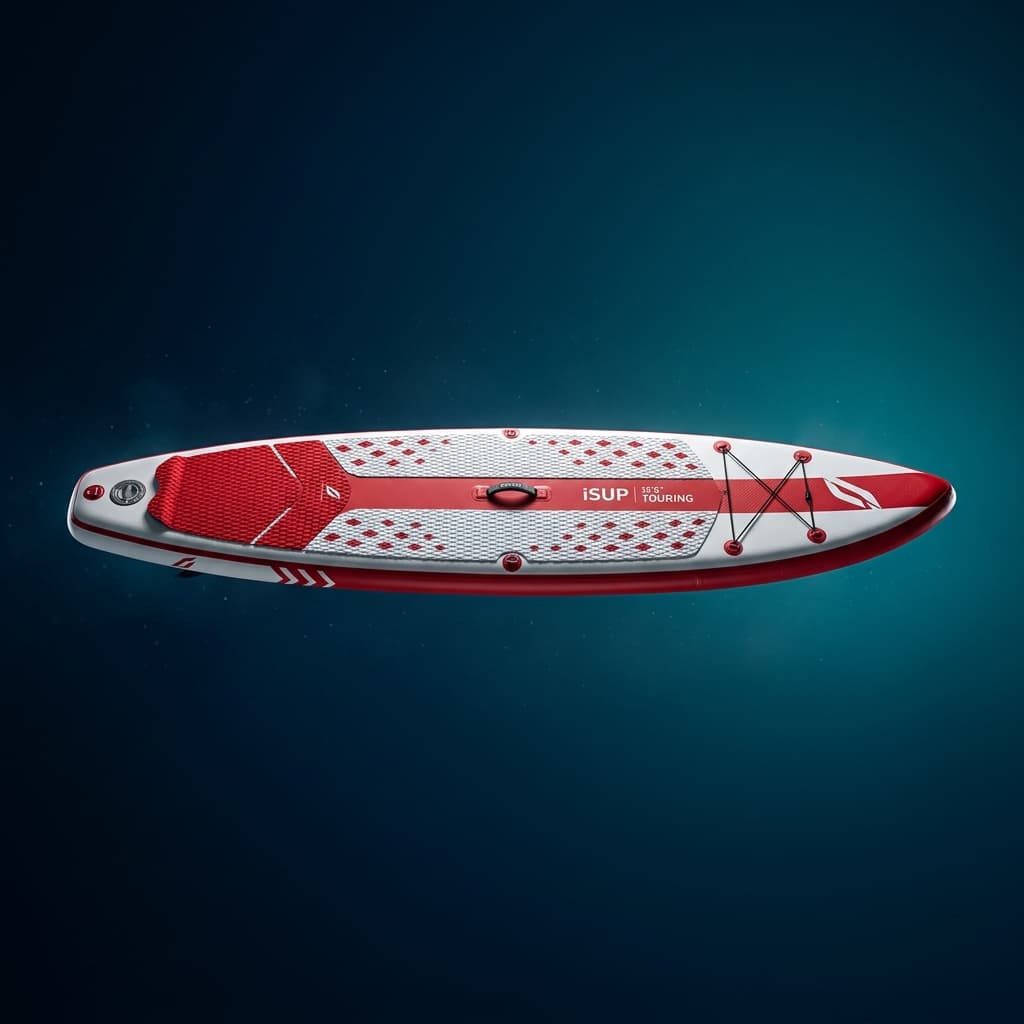
The Red Paddle Co Sport's 11'3" length and narrower touring hull behave differently from the Isle Pioneer Pro and BOTE Breeze Aero. It tracks with less correction effort — once you're moving, it holds its line with minimal paddle input.
The tradeoff: it's less immediately stable for beginners. The narrower profile requires active balance during the first 15–20 minutes for paddlers new to iSUPs. After that adjustment period, the board becomes intuitive and rewards good technique with clean, efficient speed.
In open bay conditions with a 12-knot crosswind and 6-inch chop, the Red Paddle Co tracked more cleanly than both the Isle and BOTE — holding direction with significantly fewer corrective strokes per mile. Over a long route, that efficiency adds up to a material speed advantage.
At 19 lbs, the Red Paddle Co Sport is the heaviest board in this comparison. That's a 1.5 lb difference from the BOTE and 1 lb from the Isle — detectable on a 500-meter carry but not a dealbreaker.
The included roller bag is a premium design choice: wheeled carry handle, structured frame, and storage compartments for the pump and accessories. It's the most sophisticated travel kit of the three boards — and it shows in ease of transport when you have pavement underfoot.
Sessions 1–4: flatwater orientation and baseline measurement. Rigidity testing at multiple weight loads. The 9.7/10 rigidity score was established across these sessions under controlled conditions.
Sessions 5–8: touring routes of 4–7 miles. This is where the Red Paddle Co Sport earns its premium price. The RSS batten system is genuinely different from standard drop-stitch at these distances — the board communicates load back to your legs like a hardboard, without the flex-induced fatigue you accumulate on lesser iSUPs.
Sessions 9–11: weight capacity boundary testing. At 195 lbs (88% of the 220-lb max), performance held well — clean tracking, minimal visual sag. At the limit (220 lbs exactly), performance degraded noticeably. This board has tighter operating margins than the Isle or BOTE and rewards staying well within rated capacity.
✓ Real-world verdict: For paddlers under 175 lbs who prioritize distance, speed, and long-term build quality over versatility and weight capacity — this board has no equal in the inflatable market under $1,200.